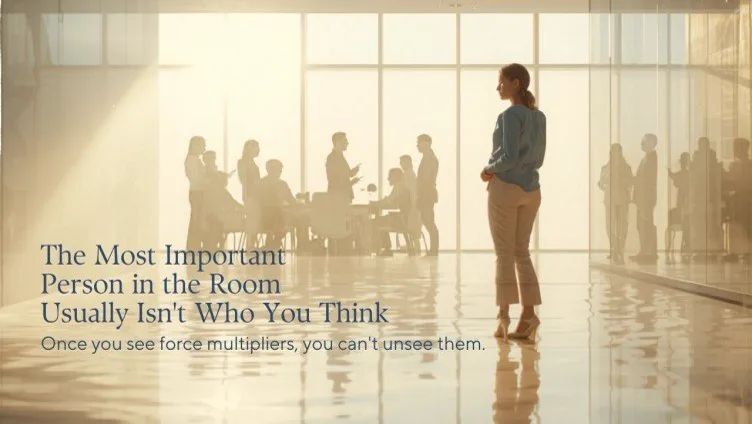
The Truth about Executive Presence Training
We have misunderstood the assignment.
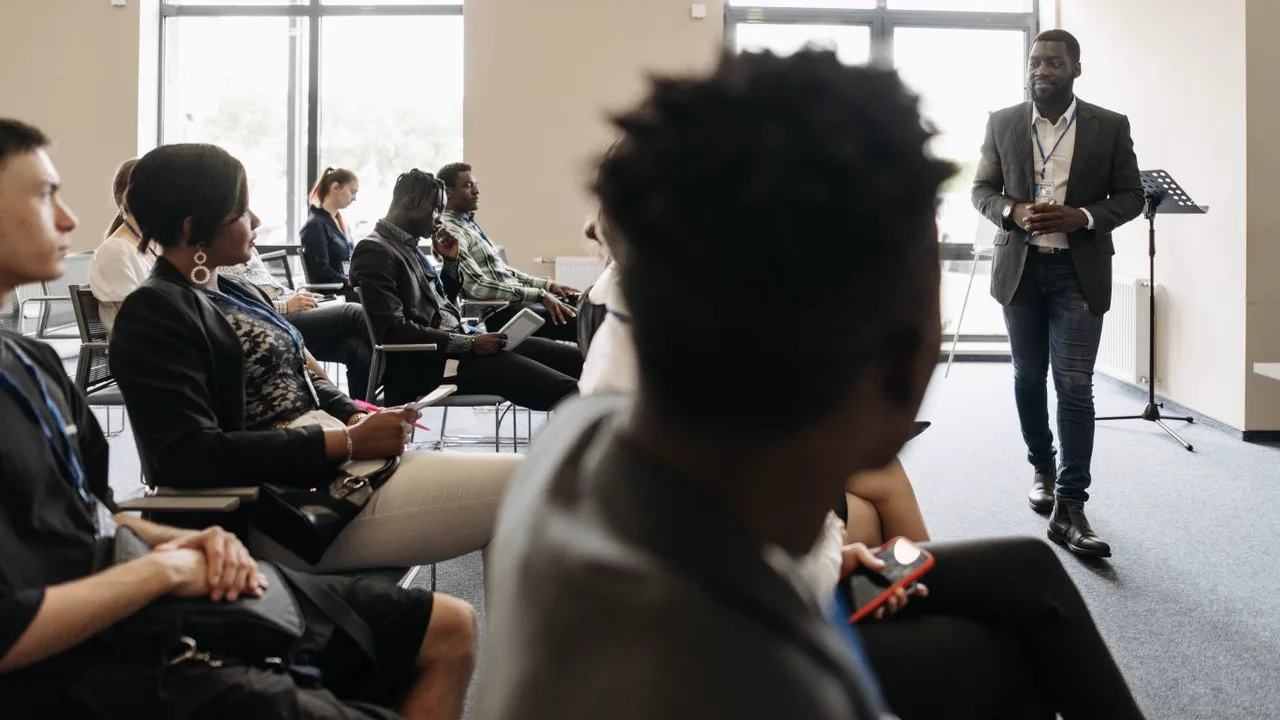
Most of us have spent years learning how to walk into rooms. Speak a little slower, sit up straighter, hold eye contact, lower your voice. Don't EVER say, "I think." Take up space. Techniques learned to help project certainty and quiet confidence.
We call it executive presence. I'm beginning to think we've misunderstood the assignment.
Most executive presence training focuses on how to convince other people that you're worth listening to. The assumption is that executive presence is something you project, a collection of behaviors that signal confidence, competence, and authority.
I bought into that idea too. I even built an entire wardrobe around it, Misook, an expensive collection of mix and match women's suits with stylish features such as frog collars. Adult Garanimals for women trying to look like they had it together before they felt like they had it together.
To be fair, none of those techniques are useless. Sylvia Ann Hewlett, who has done more than anyone to define executive presence as a field of study, describes it as a combination of gravitas, communication, and appearance. She's right, those things all matter.
But they describe what executive presence looks like from the outside. I've come to believe the real measure of executive presence is what it does to everyone else in the room. The leaders who truly have it don't change how they show up to a room. They change what becomes possible for everyone else in the room.
There is a feeling you get around certain leaders that is difficult to describe until you've experienced it. It isn't intimidation or fear or admiration or even simple respect. It feels more like relief.
Something inside you relaxes and the version of yourself you've been carefully managing starts to loosen its grip. You suddenly find you're not rehearsing your next sentence while someone else is talking. You can stop worrying about how you sound and start paying attention to what's actually being said. You can even think more clearly because you're no longer spending half your energy managing yourself.
And then something unexpected happens. You don't want to become more like them. You want to become more of yourself.
That, to me, is executive presence. It doesn't shrink the people around it, it gives them room.
An EVP of Technology and Operations at a large insurance company I worked with for years was someone whose executive presence I admired. We had worked together for quite a while, but I still caught myself measuring how much space I was allowed to take up in the presence of someone with his position. Then one afternoon over lunch, I realized I had stopped doing that.
He listened in a way that felt he was genuinely interested in what I was saying and asked questions that made it obvious he had actually heard what I said. I gained certain level of confidence that day that I had earned my seat at the table, but I also knew that it was executive presence that allowed me to see it.
At one point he mentioned a health concern, an eye floater that had been worrying him. Most business lunches begin with safe conversation about kids, travel, or sports. Instead, he shared something that was actually on his mind.
Somewhere during that conversation, the distance I had been keeping between us disappeared. We stopped being an executive and a consultant and became two people having an honest conversation. Because he wasn't managing the moment, I stopped managing it too. I said what I actually thought and we had a very real conversation.
Most executive presence training treats presence as something you practice in front of a mirror. Better posture, improved pacing, perfected body language, a more commanding voice. Those things matter around the edges, but they are the shadow executive presence casts, not the source of it. The source is much deeper.
Real presence comes from closing the gap between who you are and who you allow yourself to be when other people are watching. When that gap gets smaller, people trust more quickly, ask better questions, and admit what they don't know. They challenge ideas instead of protecting egos. And the organization becomes better because people are finally bringing their best thinking into the room instead of their safest thinking.
You can train someone to pause before they answer or where to put their hands, you can teach them how to sound more confident. None of those things matter very much if they're still convinced they have to perform in order to deserve their seat at the table. Those aren't communication problems, they're identity problems.
People perform because, somewhere along the way, many of us learned that the real version of ourselves wasn't enough.
The leaders who carry genuine executive presence have usually done enough of their own work that they no longer need to prove they're the smartest person in the room. They are able to change their mind without feeling diminished and admit uncertainty without losing authority.
And they can tell the truth, even when it would be easier to protect an image. The best part is that everyone around them becomes a more honest and more transparent too, because they can.
The next time you leave a meeting thinking more clearly than when you walked in, pay attention to why. Chances are, someone in that room created enough freedom that everyone else stopped performing. That is the real thing.
Most of us have spent years learning how to walk into rooms.
The best leaders spend their lives learning how to make it easier for everyone else in the room to BREATHE.
The Signal
Observations like this, delivered directly.
No spam. No filler. Just the patterns that matter.